
The French Sound E: A Complete Pronunciation Guide (with Audio)

One of the biggest challenges for English speakers learning French is the letter E. Unlike English, where the letter E has a limited number of pronunciations, French features several different E sounds that can change depending on the word and context.
In French, we distinguish between letters and sounds. A letter is what we write, while a sound is what we hear and pronounce. The same sound can often be written in different ways, and the same letter can represent different sounds depending on the word and its position.
In this post, we will include audio examples to help you hear and practice the different French E sounds, making pronunciation easier and more intuitive.
Table contents
1: The Schwa – /ə/
2-the closed E: é /e/
3-the open E: è, ê, ai, ei /ɛ/
4- Minimal Pairs /e//ɛ/
5-the mute E: e /ə/ or silent
6-Short reading practise
1- The Schwa – /ə/
The letter e can also represent another French vowel sound called the schwa (/ə/).
Unlike the silent e, which is not pronounced at all, the schwa is a real vowel sound. It is heard in many of the most common French words and appears frequently in everyday speech.
This sound is usually written with the letter e.
je
le
de
se
que
ne
petit
demain
venir
fenêtre
Notice that in all these words, the letter e is pronounced as /ə/.
Je te le donne.
Je me promène.
Le petit garçon arrive.
Demain, je travaille.
Je ne comprends pas.
2- The Closed E Sound – /e/
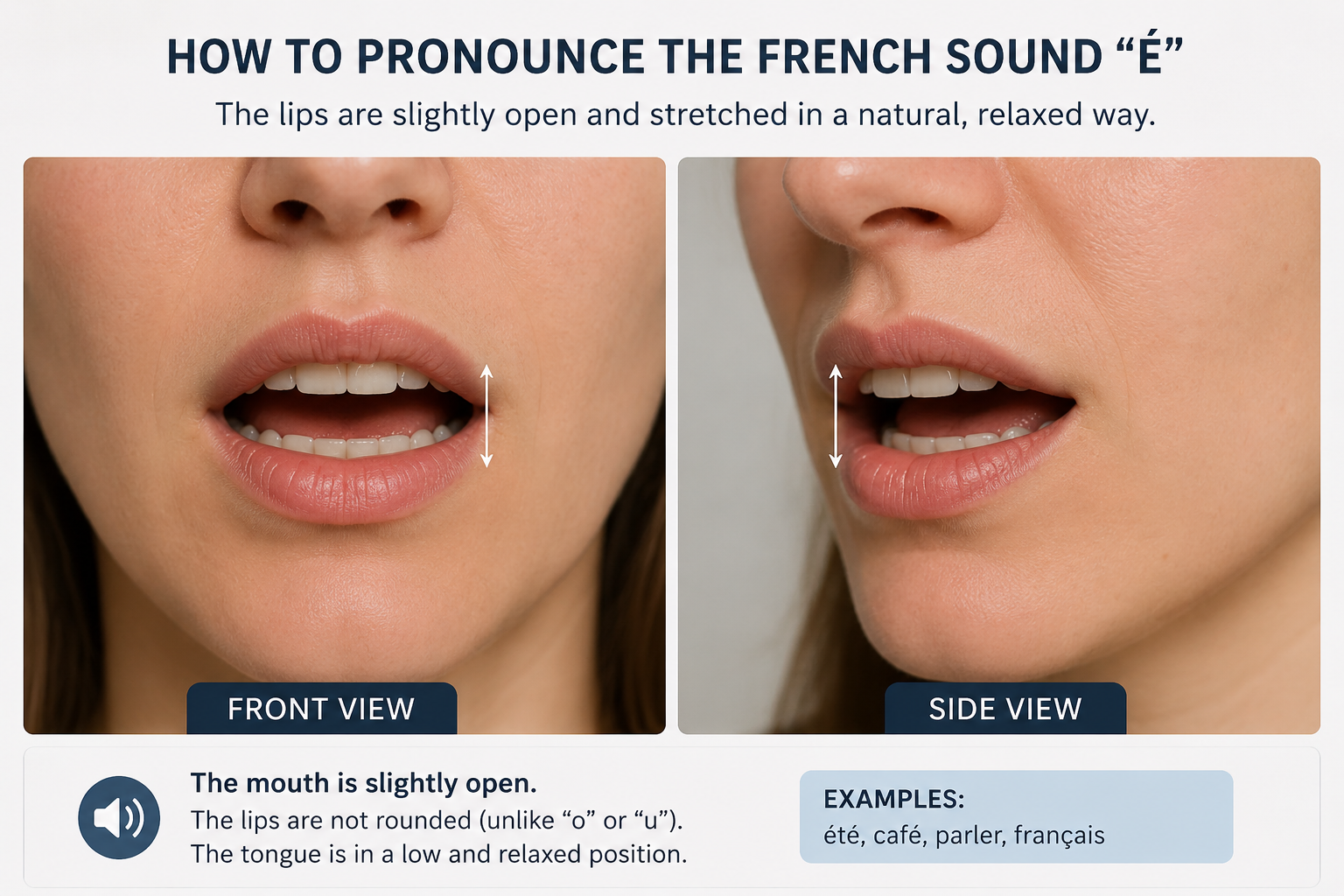
IA image
This sound is similar to the vowel in the English word "say", but shorter. Do not let your voice glide into another sound.
It is usually written:
é
er (at the end of verbs)
ez
école
été
café
clé
bébé
marché
parler
manger
vous parlez
vous mangez
Le premier
J'aime le café.
L'été est très chaud.
Vous parlez français.
Le bébé dort.
Le marché est ouvert.
3- The Open E Sound – /ɛ/
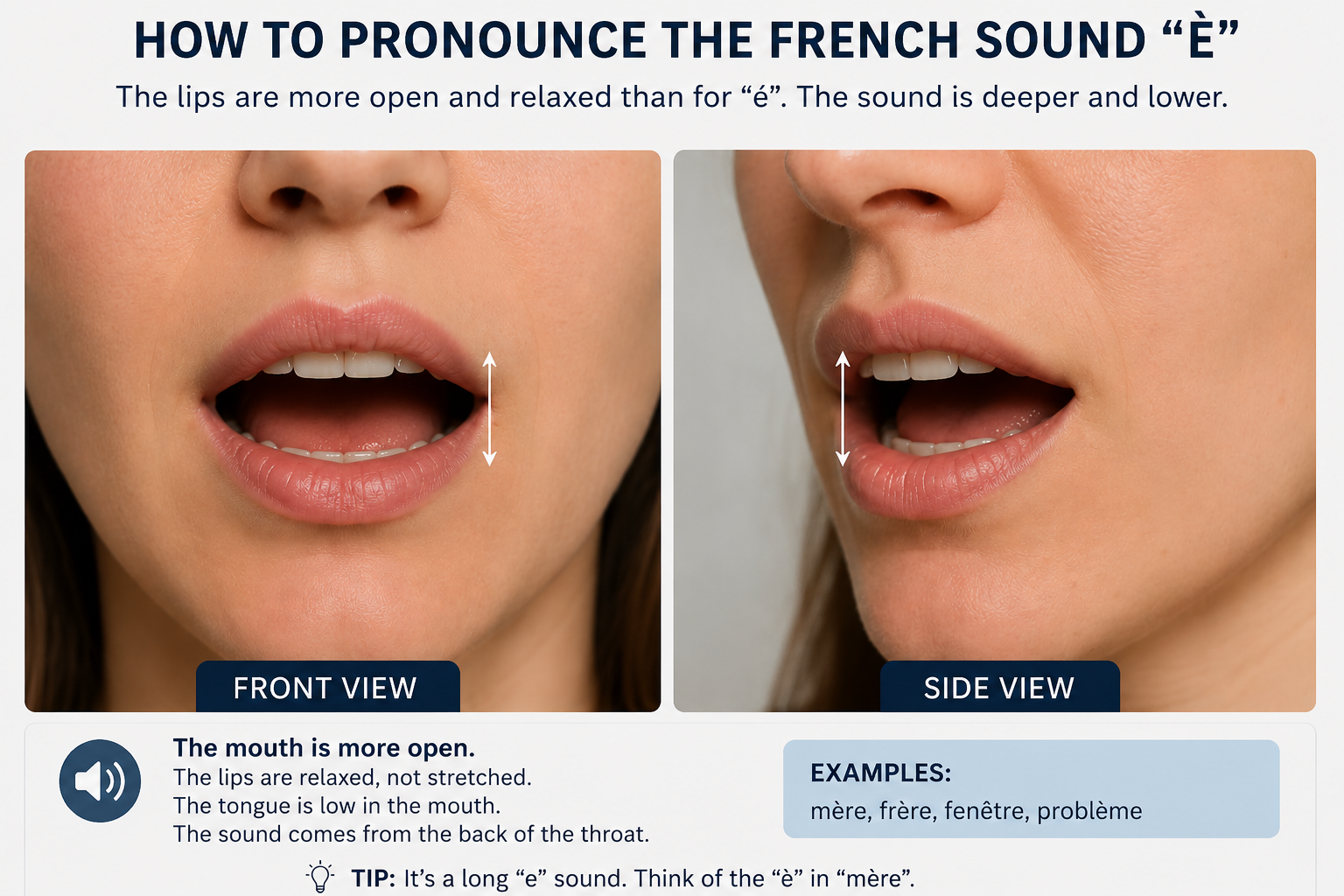
IA image
Open your mouth a little more than for é.
The open e sound is found mainly in closed syllables.* It may be spelled e, è (e accent grave), or ê (e accent circonflexe) and is equivalent to English’s short e sound, as in "set."
This sound is often written:
è
ê
ai
ei
et
sometimes e before two consonants
mère
père
frère
très
crème
fête
forêt
neige
treize
maison
lait
fait
sept
merci
belle
Ma mère aime la crème.
Mon père est très gentil.
La fête est belle.
Merci beaucoup.
Il fait très beau.
4-Minimal Pairs
A small change in pronunciation can change the meaning.
é /e/
versus
è /ɛ/
parlé – parlait
été – était
pré – près
mes – mais
des – dès
Il a parlé hier.
Il parlait souvent.
C'est l'été.
C'était une belle journée.
5- The Mute E – /ə/
One of the most surprising features of French pronunciation is that the letter e is often not pronounced at all.
In many words, especially at the end of a word, the final e is completely silent. It has no sound, although it often changes the pronunciation of the preceding consonant.
Rule 1: Final e is usually silent
table
porte
robe
minute
Rule 2: The silent e often marks the feminine form.
The final e is silent, but it changes the pronunciation of the preceding consonant.
Compare:
petit → petite
grand → grande
français → française
Rule 3: Many verb endings contain a silent e.
je parle
tu regardes
il arrive
Rule 4: Silent e inside words
Sometimes an e written inside a word disappears in natural pronunciation.
· samedi → sam'di
· revenir → r'venir
· lentement → lent'ment
· fenêtre → f'nêtre
· petit → p'tit
· semaine → s'maine
· regardez → r'gardez
· venir → v'nir
The pronunciation becomes lighter and more fluid. For example, many native speakers pronounce: Samedi almost like sam'di or je reviendrai almost like j'reviendrai. This happens especially in informal spoken French.
6- A Short Reading Practice

Bonjour !
Je m'appelle Pierre.
J'habite près de la forêt.
Chaque été, je vais au marché avec ma mère.
Nous achetons du café, du lait et de la crème.
Le petit garçon aime les fêtes.
En France, le temps change souvent.
Demain, je vais parler avec mes amis.
C'est une belle journée et je suis très content.
Learn French with French à La Carte

Private French lessons - French à La Carte
French à La Carte is specialized in one on one lessons in Paris and online.
We offer tailor-made French lessons with highly qualified native French tutors.
If you are looking for :
Conversational French
French for professionals
Lessons in the evening & on the week-ends
Immersive lessons in Paris
Exam preparation ( TCF, DELF, DALF)